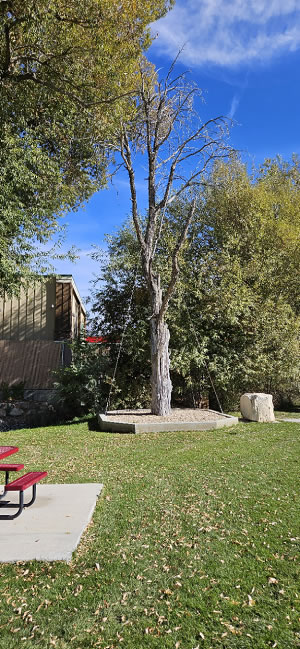
The Old Peace Treaty Tree
The Old Juniper Tree
Resiprocity
-by author and historian Phillip B Gottfredson
Of all the Black Hawk War monuments in Utah, one stands above the rest: the "Peace Treaty Tree" in Ephraim, Utah. It stands above others because it recognizes the greatness of the human spirit. It marks a time when two men from vastly different backgrounds made a sacred vow to look beyond their differences and end the bloodshed—a Black Hawk War story of reciprocity that should be remembered and never forgotten.
On June 10, 1866, Antonga Black Hawk was wounded while in battle at Gravelly Ford near Seipio. Having driven off some cattle belonging to old man Ivy in Round Valley, he was shot in the stomach by James E. Snow while attempting to rescue a fallen warrior, Whitehorse. Black Hawk was a Timpanogos War Chief subordinate to his uncle, Chief Tabby, the principal Chief of the Timpanogos.
Canute Peterson of Ephraim visited the ailing Timpanogos leader Black Hawk, who was east of Ephraim, healing from his wound. Canute took gifts of sugar, hams, bread, beads, molasses, tea, coffee, tobacco, flour, medicines, and clothing. Timpanogos Chief Black Hawk was grateful for the gifts, and their friendship grew, which helped end the hostilities.
When the chief well enough to travel, he and five important chiefs visited Canute Peterson's home to express their respect and appreciation. As they talked, "Sarah Peterson prepared a meal of the good things that could be brought from the cellar and pantry." Source: July–August 1939 — Story of the Life of Canute Peterson Source: July–August 1939 — Story of the Life of Canute Peterson
After a good meal, Black Hawk and Canute smoked the pipe of peace under the old juniper tree, now called the "peace treaty tree." The old Juniper tree still stands on the south bank of the creek. There, they agreed not to fight, and their friendship would last as long as water continued to run in the creek. A Black Hawk Peace Treaty marker was erected there in 1982. And, by the way, the creek still runs.
The Juniper is a sacred tree to First Nations people. It's a medicinal plant traditionally used for healing and in ceremonies. It also provided sustenance in difficult times. The symbolism, then, is powerful. Black Hawk chooses the Juniper to smoke the sacred pipe under and make their promises. Honoring ancient traditions, the Chief affirmed their friendship and commitment to each other. Both acknowledged their spiritual connection; they made a sacred vow to live in harmony. Does this not demonstrate the humanity, virtue, and compassion of Antonga Black Hawk and his friend Canute Peterson? Just a kind, heartfelt gesture from Canute, and Black Hawk willingly offers the sacred pipe to honor Canute's kindness and compassion.
In contrast, Brigham Young spent millions in church funds to "exterminate" the Timpanogos, which began with the Battle Creek Canyon Massacre in 1848. Perhaps all people needed to soothe tensions during the Black Hawk War was a little unconditional love and mutual respect. Instead of celebrating the sword, we could honor the humanity of these two men.
But more Sevier than the physical pain Black Hawk was suffering, and the mental trauma, Black Hawk could not rest until he found peace for his people. Peter Gottfredson gives this account: “There are probably a dozen men in Utah who claim the honor of killing Black Hawk, none of which is true. It is true that Black Hawk was severely wounded in the fight at Gravelly Ford on the Sevier River, near what is now called Vermillion; but he lived three of four years after receiving the wound; and before his death Black Hawk obtained permission from the military authorities of the Territory to visit all the places where he and his tribe had caused trouble or raided. And accompanied by a few (seven or eight) warriors, Black Hawk visited every town and village from Cedar City on the south to Payson on the north (a distance of 180 miles) and made peace with the people. On this "mission of peace" he was provided with an escort, usually from two to six citizens, from town to town. Ansel P. Harmon and myself acted as such escort from Holden to Scipio, Millard County. Source: Indian Depredations In Utah
Benjamin Johnson and Guffick
Not all Mormon colonists conflicted with the Timpanogos Nation. I recall another exciting story that Benjamin F. Johnson of Spring Lake wrote in 1855 about his Timpanogos friend known as Guffick: "I saw someone moving in the brush at the foot of the mountains, and thinking it might be Guffick, I started in that direction. Seeing me (Guffick) hurriedly came, clasped me in his arms and wept. I asked him with his family and friends, to come and live with me through the war. I would give my life for his did anyone kill him or his. He said he could not, for if the Mormons did not kill him the Indians would, should he do so. His grief of the war then going appeared extreme, and at parting he again hugged me and wept as before. Such was his integrity to me, and our mutual confidence and love for each other that to but a few would I have entrusted my life sooner than with him."
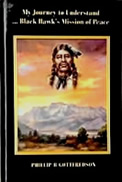
Tribal elders, and my Native friends said this to me when I was researching my book My Journey to Understand Black Hawk's Mission of Peace: "The message of Indigenous America is connection, relationship, and unity. All people are one. One of the direct, living descendants of Creator." Chief Joseph says, "We have no qualms about color. It has no meaning. It doesn't mean anything. When we are together, we are one. Nothing can break it." This is the same message Chief Sitting Bull conveyed when he said, "The heart knows not the color of the skin. This is an ancient traditional teaching. It still lives among our true traditionalists everywhere. The power of forgiveness is greater than hate; love vanquishes condescension and discrimination. That is the power our elders, our true traditionalists, hold. They are treasures; they are the most beautiful people on Earth."
And I believe that was Black Hawk's message too, when he made his last ride home to pass out of this world in peace. He was in severe pain, dying from a mortal wound to his stomach. His heroic journey was Black Hawk's 'mission of peace,' but it gets left out of Utah's history. I most sincerely congratulate the people of Ephraim City for having preserved the old Peace Treaty Tree. It honors the friendship made over 160 years ago between Timpanogos Chief Antonga Black Hawk and Canute Peterson. It is extraordinary to think that a promise made so long ago is still remembered. Thank you, Ephraim City, and may you always be blessed with beauty and prosperity.
Treaties
Note: Let's talk about treaties for a minute. In an interview between Phillip B Gottfredson and Dr. Floyd O'Neil at the University of Utah, O'Neil explained that "no treaties were made between the Indian people of Utah and the Church of Jesus Christ of Latter-day Saints (Mormons)." He explained that 'agreements' were made between the Mormon Church and the indigenous people. "At best, these agreements were divisive to trick the Indians into giving up their land," he said. The Federal Government was the only one with the legal authority to make treaties. Cities such as Heber, Mt. Pleasant, Ephraim, Cedar Valley, and others claim to have made treaties, but Congress never ratified any.
The Spanish Fork Treaty between the Timpanogos Nation and the United States government would fail ratification by Congress as it bore the signature of Brigham Young, thus leaving the homeland of the Timpanogos intact. Congress declared, "rather than associate with Brigham Young on such an occasion, they would have the negotiations fail; they would rather the Indians, than the Mormons, would have the land." Source: Commission of Indian Affairs Annual Report 1865, O.H. Irish (Source: Department of the Interior) See Spanish Fork Treaty, 1865
My purpose in correcting the historical record is not to diminish the significance of the Old Peace Treaty Tree, but to elevate its story and bring its deeper meaning into focus. The friendship between Antonga Black Hawk and Canute Peterson deserves to be remembered in its own right, not overshadowed by a later claim about a treaty. Their meeting beneath the juniper tree reminds us that even in times of conflict, compassion, reciprocity, and mutual respect can bring people together. By distinguishing this remarkable act of friendship from the separate 1868 treaty claim, we can better understand what makes this historic place so meaningful—and why its story deserves to be preserved for generations to come.
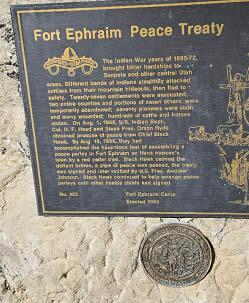
FORT EPHRIAM PEACE TREATY
Recently, I revisited one of my favorite monuments, in Ephriam, Utah. Though the old juniper tree has since died and is supported by cables to prevent it from falling, I am grateful for the efforts to preserve it until the park managers decide what to do with the present monument.
I took a photo of the existing plaque below the old juniper tree, and in the last sentence, it says, a treaty was signed and later ratified by Pres. Andrew Johnson."
The key problem is the claim of presidential ratification: The plaque says President Andrew Johnson ratified the agreement. This is the clearest, most problematic statement. The National Archives preserves U.S. Native American treaties in its treaty records. Its published catalog lists the recognized ratified treaties, including the 1868 treaties with the Ute and with the Eastern Shoshoni and Bannock. It does not list a Fort Ephraim treaty in the National Archives.
The key legal point is that President Andrew Johnson could not ratify Indian treaties on his own. At that time, treaties required Senate approval. So, the plaque’s claim that Johnson ratified the agreement is not supported by the official treaty record we found. This does not mean there was no peace meeting or local agreement. It means we need to separate a reported peace agreement from a federally ratified treaty.
The important point is that Indian Agent Franklin Head and Bishop Orsen Hyde met with the good intention of bringing an end to the Black Hawk War. I believe they met and made an agreement because Black Hawk had met with Franklin Head a year earlier and assured him he wanted to pursue peace and end the bloodshed.
Chief Black Hawk continued to campaign for peace until he died in 1870. Peter Gottfredson refers to Black Hawk's "mission of peace" in his book Indian Depredations in Utah. I wrote a companion book to Peter's book about his peace mission titled "My Journey to Understand Black Hawk's Mission of Peace."
Next: The Timpanogos are not Ute
|

 Order now,